
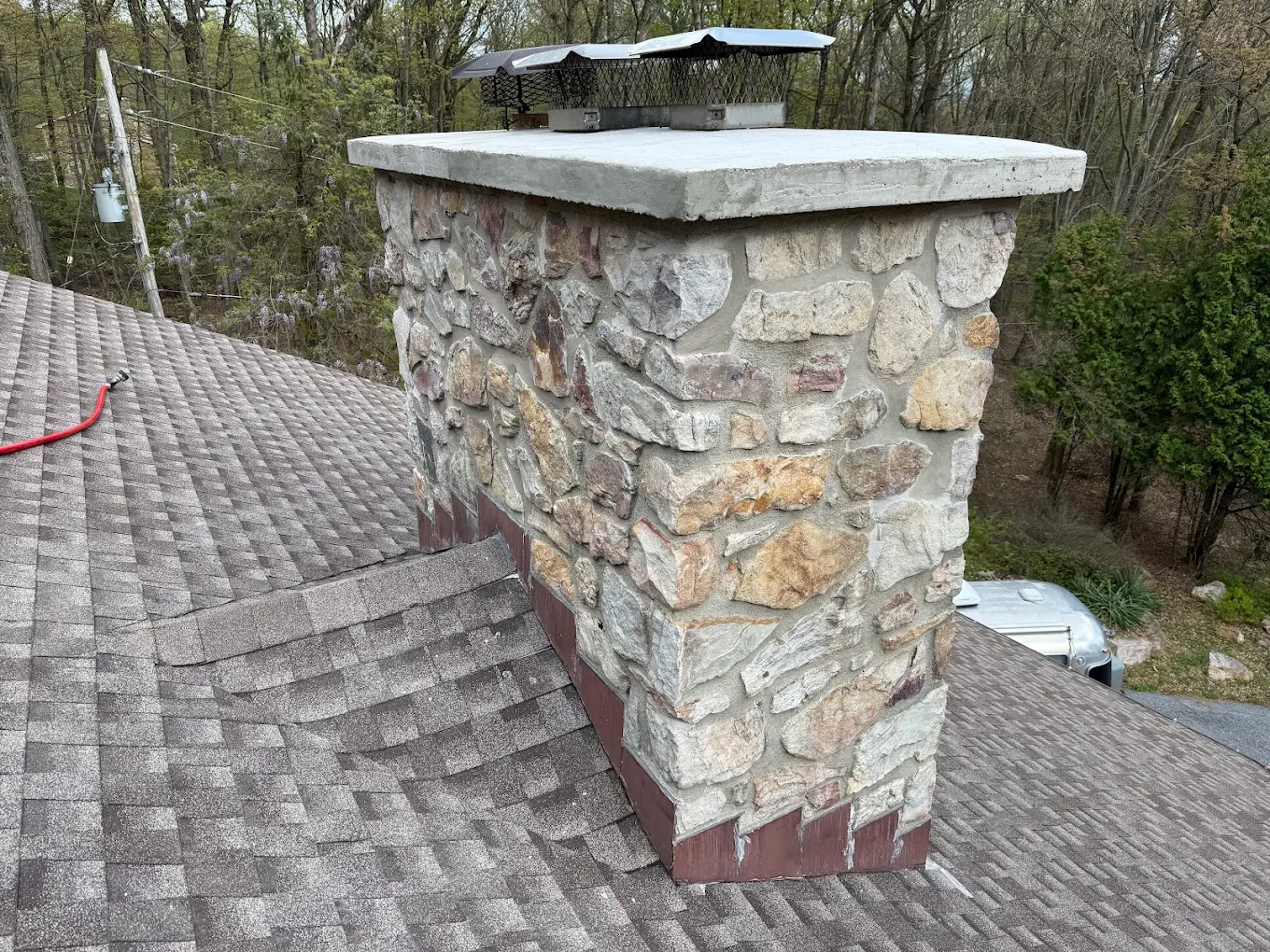
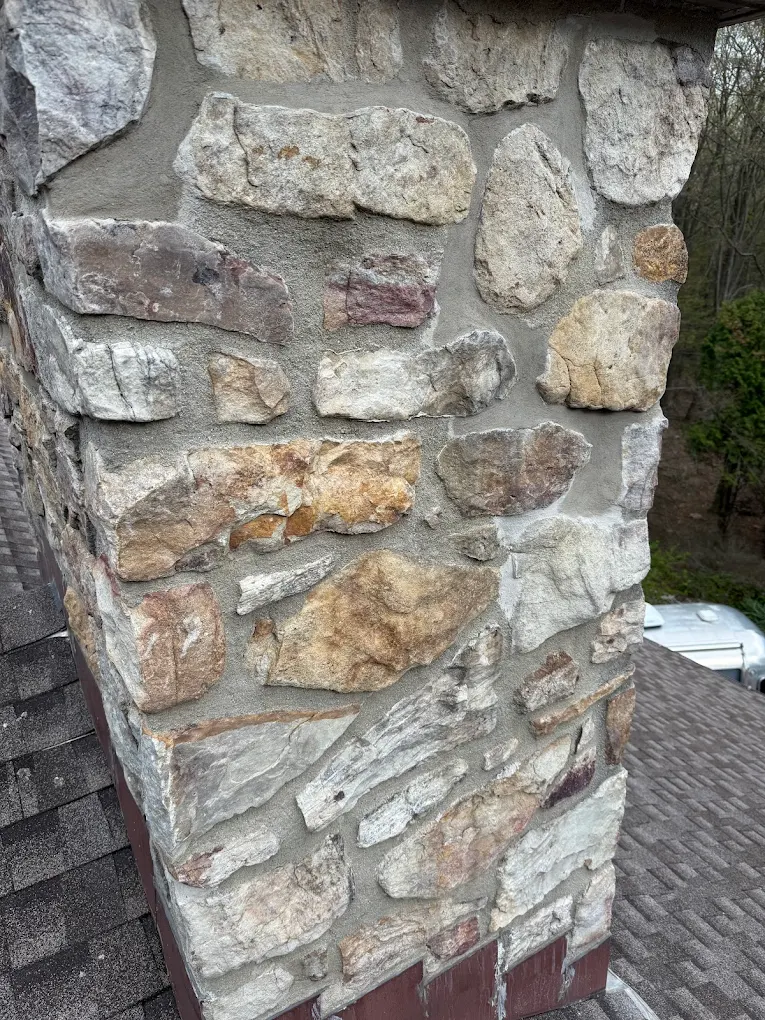
Close-up mortar detail and full chimney view after rebuild. York, PA. Spring 2025.
L
LBE Masonry Team
Licensed Masonry Contractors, York County PA
Stone masonry is where the craft either shows or it does not. You can see the quality of a mortar job from the driveway if you know what to look at. We make sure our work holds up to that kind of attention.
Most homeowners never look closely at the mortar joints on their chimney. That is understandable. But when something goes wrong up there, the mortar is almost always where it started.
These photos are from the chimney rebuild we completed in York this past spring. The close-up shot on the left is what we want every homeowner to see, because it shows something that is easy to describe but hard to appreciate without actually looking at it: what correctly matched, properly applied mortar looks like on natural fieldstone.
Every joint in this chimney was ground out to remove the failed original mortar, packed with a portland-lime blend mixed to match the color and texture of the surrounding stone, and tooled to a consistent profile before the mortar had cured. None of this is visible from the street. That is the point.
The best mortar work is the kind nobody notices. It just looks like the chimney was always built right.
That is what we are going for on every job.A confession: We took the close-up photo ourselves because we were proud of how the joints came out on this one. The homeowner was pleased with the finished chimney. We were pleased with the mortar. Different things make different people happy. We are fine with this.
Why Mortar Matching Matters More Than Most People Think
On a stone chimney repair or rebuild, the mortar is not background. It covers as much visual surface area as the stone itself. Get the color wrong and the chimney looks repaired. Get the texture wrong and it looks like someone used the wrong product. Either way, it reads as wrong from twenty feet away even if the person looking at it cannot explain why.
Matching mortar on natural fieldstone is harder than it sounds because fieldstone has natural color variation across the face of each individual stone. There is no single “right” mortar color. The goal is to find a blend that sits neutrally against the range of colors in the stone without pulling the eye toward the joints or away from them.
On this York County chimney, the original stone had a warm gray-beige base tone with tan, brown and occasional reddish fieldstone mixed in. We tested three mortar blends on a small section before committing to the full job. The final mix was a portland-lime blend with a pigment ratio that read warm gray in direct sun and beige-gray in shade. That is the range you need to hit with Pennsylvania fieldstone.
What goes wrong
Hard gray portland cement mortar on old soft stone. Looks obviously new, bonds poorly, and forces cracks into the stone face rather than the joint when the structure moves.
What we use
Portland-lime blend matched to the existing stone tone. Softer than the stone so it takes movement without cracking. Color matched on-site before the first joint is packed.
Lime Mortar vs Portland Cement: Why the Difference Matters for Old Stone
This is one of the most important things to understand about stone chimney repair in York County, especially on pre-1960 homes.
Most stone chimneys built before World War II used lime-based mortars. Lime mortar is softer and more flexible than modern portland cement. It was designed to move slightly with the structure as temperature and moisture conditions change, absorbing that movement in the joint rather than transmitting it to the stone.
When you repoint old soft stone with hard portland cement, you reverse this relationship. The mortar becomes stronger than the stone and any movement in the structure now cracks the stone face instead of the joint. We have seen chimneys where well-intentioned but incorrect repointing caused more damage than the original deterioration it was meant to fix.
Preservation standard: The National Park Service Preservation Brief 2 on repointing mortar joints in historic masonry is the definitive resource on this subject. It specifically addresses the danger of using mortars that are harder or stronger than the masonry units being pointed. For any pre-1960 stone structure in York County, this document is worth reading before you hire anyone to do repointing work.
On chimneys built after 1960 with modern hard brick or dense stone, portland-based mortars are generally appropriate. The key is matching the mortar to what is already there, not using whatever is cheapest or most available.
How to Tell If Your Chimney Mortar Was Done Wrong
If a previous contractor did repointing work on your chimney and you are not sure whether they used the right product, here is what to look for.
- Cracks running through the stone face rather than along the joints This is the classic sign of mortar that is too hard for the stone. The structure moved and the crack went through the stone because the joint was stronger.
- Mortar that is visibly lighter or grayer than the original joints Fresh portland cement is noticeably lighter than cured lime mortar. If the repaired joints look like they are a different color than the rest of the chimney, they probably are.
- Joints that are overfilled or smeared over the stone face Sometimes called “parging.” The mortar has been applied too thickly and spread onto the stone face to hide poor joint work. This traps moisture and accelerates deterioration.
- Hollow sound when you tap the mortar Properly bonded mortar sounds solid. Mortar that was applied without adequate preparation of the old joint will delaminate and sound hollow when tapped with a coin or key.
Verified Google Review
★★★★★
I had two other contractors look at this chimney and neither one mentioned the mortar type or explained why the previous repair had failed. LBE explained everything before they started and the finished work looks exactly like the original chimney. You genuinely cannot tell it was touched.
What Good Stone Repointing Looks Like Up Close
The close-up photo at the top of this post shows finished repointing on natural fieldstone. Here is what to look for when evaluating any stone masonry work, including work you might be getting bids on right now.
Consistent joint depth. The mortar face should sit slightly recessed from the stone face, typically between 1/4 and 3/8 of an inch. Not flush, not deep. Flush mortar does not shed water. Too-deep joints collect debris and hold moisture.
Consistent profile. The tooled surface of the joint should have a uniform concave or rodded profile across the entire chimney. Inconsistent tooling is a sign of rushed work or inexperienced labor.
No mortar smeared on the stone face. The stone itself should be clean. Any mortar on the stone face that has not been cleaned off within the curing window will haze the stone and is very difficult to remove without damaging the surface.
Color match across new and old joints. On a partial repoint, the new joints should blend with the old ones well enough that you cannot immediately identify which joints were replaced. This takes experience and on-site mixing. It cannot be done with off-the-shelf bagged mortar at a fixed ratio.
Ask before you hire: On any stone repointing estimate, ask the contractor specifically what mortar product they plan to use and what the lime-to-portland ratio is. If they cannot answer that question, they are not the right contractor for a pre-1960 stone structure. The answer matters and an experienced mason will know it.
Stone Chimney Repointing Across York County
We do stone chimney repointing, mortar repair and full chimney rebuilds throughout York County and Adams County. If you have a stone chimney and you are seeing open joints, white staining or mortar debris in your gutters, that is worth having someone look at before next winter.
📍 York, PA
📍 Shrewsbury
📍 Glen Rock
📍 Hanover
📍 Spring Grove
📍 New Freedom
📍 Carroll Valley
📍 Adams County
Have a Stone Chimney That Needs Attention?
Send us a photo from the ground or the roof and we will tell you what we see and what it will take to fix it. Straight answer, no pressure, no obligation.
Get a Free Chimney EstimateProject Details
Job Summary
Location
York, PA (York County)
Work Done
Full stone chimney rebuild with mortar matching, new concrete crown, new chimney cap, flashing reseating
Mortar Used
Portland-lime blend, color matched on-site to existing fieldstone
Stone Type
Natural fieldstone, warm gray-beige with tan and reddish variation
Completed
Spring 2025