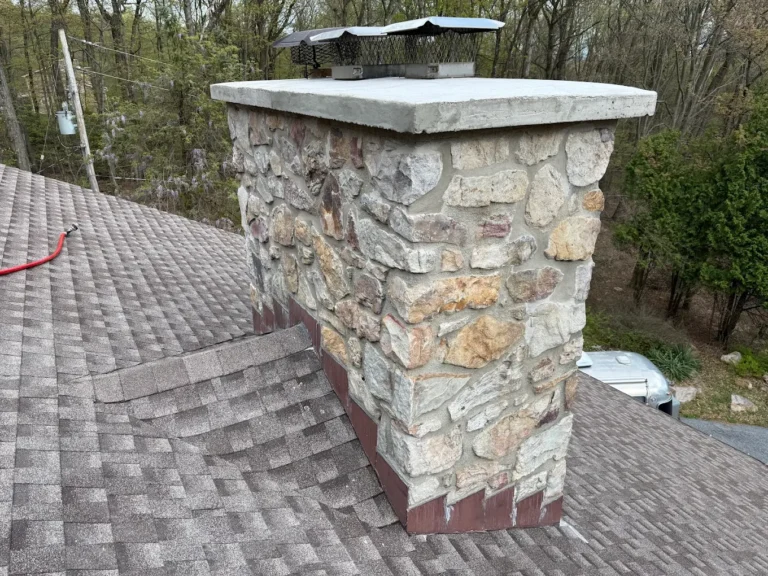

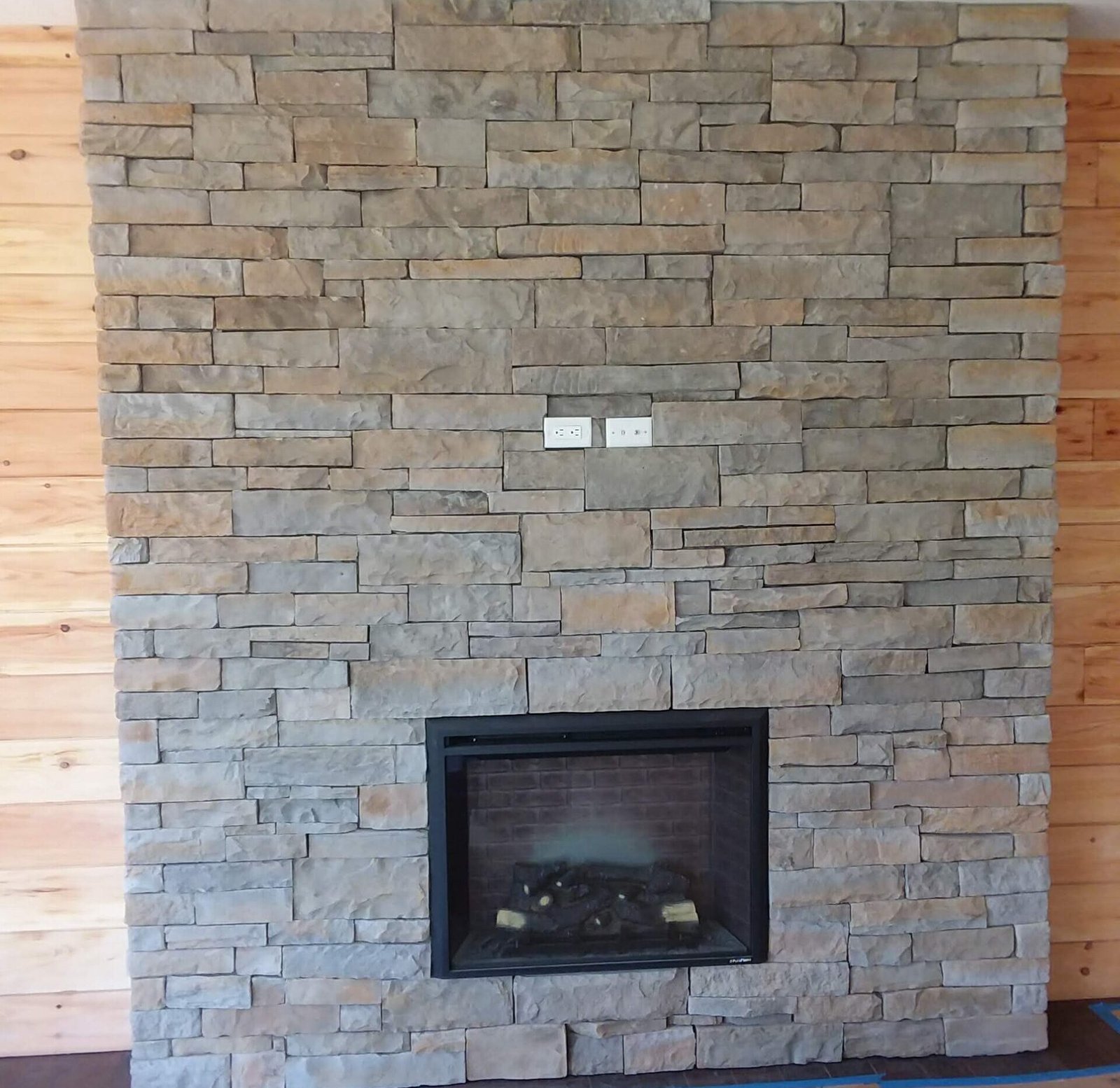
Floor-to-ceiling stacked stone veneer fireplace surround with gas insert, York County PA. Completed 2019.
L
LBE Masonry Team
Licensed Masonry Contractors, York County PA
Stone veneer fireplace walls are some of the most visible masonry work we do. Every piece of stone is chosen individually and placed by hand. The layout decisions made in the first hour determine how the finished wall reads from across the room.
When the room has pine walls and a wood floor, a drywall fireplace surround is not going to work. This homeowner in York County knew exactly what they wanted: stone, full wall, floor to ceiling, something that made the fireplace feel like the reason the room exists.
This was a new construction project. The home was still being finished when we came in to do the stone work. Fresh pine shiplap on the walls, hardwood floors going in, the gas insert already roughed in. Our job was to build a full-height stone veneer wall around the fireplace opening that would anchor the entire room design.
The stone selected was a ledgestone veneer with warm beige, tan and gray tones that picked up the color of the pine walls without competing with them. The format is what most people call stacked stone: rectangular pieces of varying length laid in roughly horizontal courses with tight joints and a face-split texture that catches light across the surface.
A floor-to-ceiling stone wall is a commitment. Once it is up, it defines the room. Get it right and people walk in and immediately understand what kind of space this is.
This one got it right.Genuine moment from this job: We were about halfway up the wall when the homeowner came in and stood there for a while without saying anything. We asked if everything was okay. She said: “I just need to stand here for a minute.” We took that as a good sign and kept working.
What This Project Involved
A floor-to-ceiling stone veneer wall is more involved than a standard fireplace surround. The scale changes everything from the substrate preparation to the layout planning to the sheer volume of stone being handled.
01
Substrate Preparation
Stone veneer requires a properly prepared backing surface. On new construction this means cement board or lath and scratch coat over the framed wall. The substrate needs to be flat, properly fastened and moisture-resistant before the first stone goes up. On a wall this size, a substrate that is out of plane by even a small amount will be visible in the finished work.
02
Layout Planning Before Installation
On a full-height wall, the layout decisions matter enormously. Where does each course break? How do the joints stagger across the face? How does the stone wrap at the corners of the fireplace opening? All of this is worked out on paper and on the floor before the first piece is set. Improvising on a wall this size is how you end up with a finished result that looks like it was improvised.
03
Corner and Fireplace Opening Details
The two most scrutinized areas on any stone wall are the corners and the fireplace opening edge. Corner pieces need to be tight, level and consistent in reveal. The opening edge needs a clean return that transitions smoothly from the stone face to the firebox surround. These details take more time than the flat field sections but they are what the eye goes to first.
04
Stone Selection Across the Full Wall
Ledgestone veneer comes in a range of piece sizes within each box. Part of the craft is choosing which pieces go where so the color variation distributes naturally across the wall rather than clustering. Darker pieces spread through the field. Longer pieces broken up by shorter ones. This is not something you think about consciously when you look at a finished wall. You only notice it when it was not done right.
05
Grouting and Joint Work
Tight joints were grouted to match the stone tone and raked to a consistent depth. The joint color here is intentionally close to the stone so the eye reads the surface as a continuous texture rather than a grid pattern. That is the look the homeowner was going for and it is the right choice with ledgestone at this scale.
Verified Review
★★★★★
This fireplace wall is the first thing every single person comments on when they come into our home. LBE did the work during our new build and they were the most professional subcontractor on the entire project. The stone is absolutely stunning and years later it still looks perfect. We cannot recommend them highly enough.
Stacked Stone Veneer: What It Is and Why It Works
The term “stacked stone” gets used loosely but it refers to a specific look: thin slices of natural or manufactured stone laid in roughly horizontal courses with minimal joint width, creating the appearance of tightly stacked layers. The face-split texture means each piece has a rough natural face that catches light at an angle.
It became popular in residential interiors over the past two decades because it bridges the gap between rustic and contemporary. The horizontal coursing reads as clean and organized. The natural stone texture keeps it from feeling cold or clinical. In a room with wood elements like this one, the combination works very naturally.
Manufactured stone veneer
Concrete-based product made to look like natural stone. Consistent sizing, predictable color ranges, lighter weight. Lower cost. Good performance when properly installed. Works well on most residential projects.
Natural stone veneer (this project)
Actual stone that has been split thin for veneer use. Each piece is genuinely unique. Color variation is natural and organic. Heavier, more expensive, requires more skill to install well. The result has a depth that manufactured veneer does not fully replicate.
This project used natural stone veneer. The homeowner wanted the real thing and the budget supported it. For most residential fireplace surrounds in York County, either option works well when installed correctly. The choice comes down to budget, personal preference and the overall direction of the room design.
Installation standard: The Masonry Institute of America publishes technical guidelines for stone veneer installation covering substrate requirements, mortar specifications, tie spacing for anchored veneer and clearance requirements around fireplace openings. Interior stone veneer around gas inserts requires specific clearances that vary by insert manufacturer and local code. We verify these requirements on every fireplace project before the first stone goes in.
Full Wall vs Traditional Surround: Which Is Right for Your Space
The most common question on interior stone fireplace projects is whether to do a traditional surround (stone just around the opening, up to mantel height) or go full wall from floor to ceiling. Both are valid. Here is how we think about the decision.
Gas insert clearance requirements: Natural stone, manufactured veneer, brick and tile all handle heat differently. The clearance from the firebox opening to the stone face, and the material thickness at the opening edge, are governed by the insert manufacturer’s specifications and local building code. In Pennsylvania these requirements are taken seriously. We review the insert documentation on every job and confirm clearances before installation. Do not skip this step.
Interior Stone Work Across York County
We do interior stone and brick fireplace surrounds, accent walls, hearth installations and fireplace restoration across York County and Adams County. If you are building new or renovating an existing space and want stone work done right, give us a call or send photos of what you are working with.
📍 York, PA
📍 Shrewsbury
📍 Glen Rock
📍 Hanover
📍 Spring Grove
📍 New Freedom
📍 Carroll Valley
📍 Adams County
Thinking About a Stone Fireplace Wall?
Tell us what you have in mind and we will tell you what it takes to build it. New construction or renovation, partial surround or full wall. We will give you a real answer on the first call.
Get a Free EstimateProject Details
Job Summary
Location
York County, PA
Project Type
New construction, interior stone veneer installation
Work Done
Full floor-to-ceiling stone veneer wall around gas fireplace insert, cement board substrate, corner detailing, fireplace opening return, grouting and joint finishing
Materials
Natural ledgestone veneer, warm beige-gray tone with face-split texture, polymer-modified mortar, color-matched grout
Completed
2019
Setting
New construction home with pine shiplap walls and hardwood floors, York County PA