
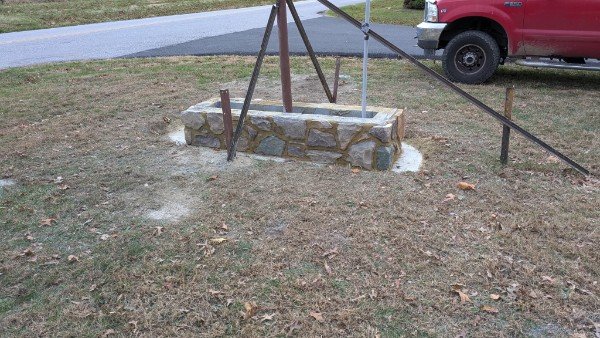
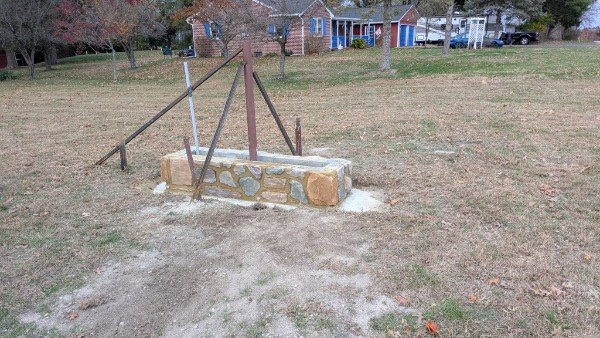
Completed stone veneer sign base with CMU block core and natural fieldstone veneer, Glen Rock PA. Fall 2025.
Commercial Project
L
LBE Masonry Team
Licensed Masonry Contractors, York County PA
Sign bases do not get enough credit. They sit at the entrance to a property and set the tone for everything behind them. A well-built stone base with a proper block core is there for decades. We have built several of these across York County and each one has its own character depending on the stone selected.
A church sign base needs to do two things well: hold up the sign structure reliably for years, and look like it belongs there. A metal pole driven into the ground does the first. Proper masonry does both.
This project in Glen Rock involved building a complete stone veneer sign base from the ground up for a church organization. The scope was fully ours, from the concrete footing to the CMU block core to the natural fieldstone veneer on the outside. The A-frame metal sign structure was provided by the client and set into the block core as the masonry went up around it.
The result is a low, horizontal masonry base that grounds the sign structure permanently and gives the property entrance the kind of presence that a pole-mounted sign simply cannot achieve. The fieldstone veneer was chosen to blend with the natural setting of the property in Glen Rock, which sits in one of the more wooded and rural-feeling parts of York County.
The difference between a sign on a pole and a sign on a proper stone base is the difference between something that was installed and something that was built.
One says the sign is there. The other says the organization is there to stay.Honest observation: Building a sign base in November in Pennsylvania requires a certain commitment to the craft. The dry grass, bare trees and general November-ness of the landscape in these photos tells you everything about the conditions. The mortar cured fine. We have learned to work with the weather here, not wait for it.
How This Base Was Built
This was a full build, not a veneer-only job. We handled every layer from the footing up.
01
Concrete Footing Below Frost Depth
A poured concrete footing below the frost line anchors the entire structure. In York County, that means going down at least 36 inches. A sign base that heaves in winter and settles in spring will crack the veneer and loosen the sign structure. Getting this right at the start prevents problems for the life of the installation.
02
CMU Block Core
Concrete masonry unit block was laid to form the structural core of the base. The A-frame metal sign structure was embedded into the block as it went up, so the steel and the masonry are integrated rather than one sitting on top of the other. This is what keeps the sign structure from shifting or rocking over time.
03
Natural Fieldstone Veneer
Natural fieldstone was applied over the CMU core to give the base its finished appearance. Fieldstone pieces vary in size, shape and color, which means every installation looks genuinely unique. The layout decisions, what goes where, how the corners are handled, how the mortar color relates to the stone, are all made on site as the work progresses.
04
Mortar Pointing and Cap
All joints were tooled to a consistent profile once the stone was in place. The top of the base was finished with a cap course that sheds water away from the core and gives the structure a clean, defined top edge.
Two Stone Sign Bases: Same Approach, Different Character
We have now built stone veneer sign bases for two different organizations in York County, and they are worth comparing because they illustrate how much the material choice changes the final result.
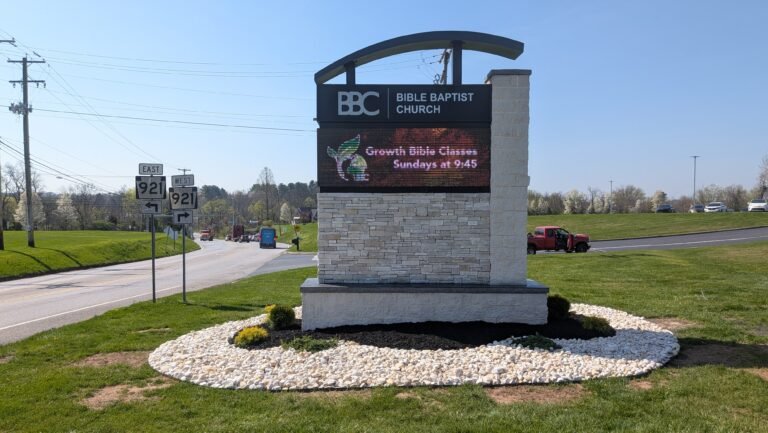
The Bible Baptist Church monument base in York used cut-face dimensional stone veneer in a lighter gray-beige tone with consistent rectangular coursing. It reads as formal and refined, which suited the scale and setting of that installation.
This Glen Rock base uses natural fieldstone with irregular shapes, warm tan and brown tones, and a more organic joint pattern. It reads as rooted and natural, which suits the property’s setting and the character of the community it serves.
Both are built the same way underneath: proper footing, CMU core, stone veneer, mortar pointing. The structure is the same. The personality is entirely different, and that comes entirely from the stone selection.
Why Stone Masonry Outperforms Other Sign Base Options
Frost depth in York County: The York County planning and zoning requirements for freestanding masonry structures require footings below the local frost depth to prevent frost heave. In York County that minimum is 36 inches. Any sign base without a proper footing at depth is a structure that will move seasonally, and movement in masonry veneer means cracking.
Sign Bases and Commercial Masonry Across York County
We build stone and brick sign bases, entrance monuments and commercial masonry for churches, schools, businesses and community organizations throughout Glen Rock and the rest of York County and Adams County. If you are planning a sign installation that deserves a proper masonry base, give us a call.
📍 Glen Rock, PA
📍 York, PA
📍 Shrewsbury
📍 New Freedom
📍 Hanover
📍 Spring Grove
📍 Carroll Valley
📍 Adams County
Planning a Sign Base or Entrance Monument?
We work with churches, schools and organizations on commercial masonry projects across York County. Send us the details and we will come out, look at the site, and give you a straight number.
Get a Free EstimateProject Details
Job Summary
Location
Glen Rock, PA (York County)
Client
Church organization, Glen Rock PA
Work Done
Concrete footing, CMU block core with embedded A-frame sign structure, natural fieldstone veneer installation, mortar pointing and cap finish
Materials
Poured concrete footing, CMU block, natural fieldstone veneer, portland-lime mortar
Completed
Fall 2025