
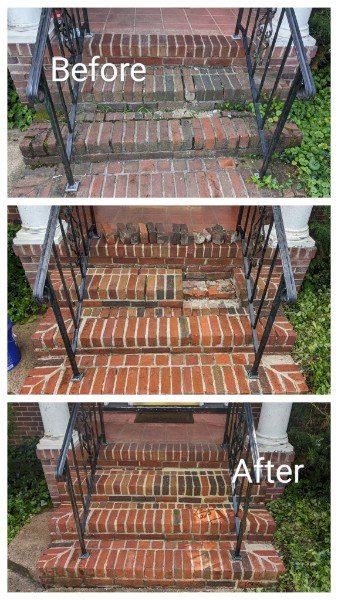
Before, mid-repair with displaced brick removed and set aside, and after: herringbone brick entry steps fully repointed and reset, Shrewsbury, PA.
L
LBE Masonry Team
Licensed Masonry Contractors, York County PA
A front entry like this one, with iron railings, painted columns and herringbone brick, is the kind of detail that defines a home’s character. When it starts coming apart, the goal is always to fix it without losing what made it special in the first place.
The railings were original. The columns were original. The herringbone brick pattern on the steps was original too, but the mortar holding it together had given up years before anyone called us.
This front entry in Shrewsbury had everything you want on an older home: wrought iron railings with the kind of detail you do not see in new construction anymore, painted columns flanking a tiled porch, and a set of brick steps laid in a herringbone pattern that takes real skill to install correctly. What it did not have was sound mortar.
Years of weather exposure and normal foot traffic had worked the joints loose throughout the steps. Several bricks had shifted out of alignment. One section in particular had deteriorated badly enough that the brick was loose and visibly displaced, with grass and moss finding their way into the gaps. It was not dangerous yet, but it was heading there, and it had already lost the clean lines that made this entry distinctive.
You do not see herringbone brick steps like this very often anymore. The goal was never to make them look new. It was to make them solid again without losing what made them special.
That balance is the whole job on a project like this.Small detail worth mentioning: The middle photo shows the bricks we pulled out lined up on the porch like evidence at a crime scene. That is standard practice on a job like this. Every brick that comes out gets inspected, and the good ones go right back in. Nothing extra, nothing wasted.
What We Did
This was a reset and repoint, not a full rebuild. The herringbone brick itself was in solid condition. The problem was almost entirely in the mortar and a handful of bricks that had shifted out of position.
01
Removal of Loose and Displaced Brick
Brick that had shifted out of alignment or come fully loose was carefully removed by hand. Each piece was set aside and inspected. The herringbone pattern means every brick sits at an angle against its neighbors, so removing pieces without disturbing the surrounding brick takes a careful touch.
02
Brick Resetting
Sound brick was reset into the original herringbone pattern with a proper mortar bed underneath. Getting the angles and alignment to match the surrounding pattern exactly is the difference between a repair that disappears and one that stands out.
03
Full Repointing of Deteriorated Joints
Every failing mortar joint across the full set of steps was ground out and repointed with fresh mortar. This was not limited to the section that had visibly failed. Joints throughout the steps were showing early signs of the same deterioration, so we addressed the whole surface rather than just the worst spot.
04
Final Cleaning
The entire entryway was cleaned once the masonry work was finished, including the surrounding brick risers and the area around the iron railings. A repair like this should leave the whole entry looking refreshed, not just the section that was worked on.
Verified Google Review
★★★★★
Our front steps are over a hundred years old and we were terrified someone would try to talk us into replacing them with something modern. LBE understood right away that we wanted them fixed, not changed. The herringbone pattern looks exactly like it always did, just solid now instead of falling apart. They clearly respected the house.
Why Herringbone Brick Steps Are Worth Preserving
Herringbone is a brick laying pattern where each brick is set at a diagonal angle, alternating direction to create a zigzag visual effect rather than the straight rows you see in running bond. It is more labor intensive to install than standard patterns and was common on higher-end homes built in the early to mid twentieth century throughout Pennsylvania.
When herringbone brick fails, the temptation for some contractors is to suggest tearing it out and replacing it with something simpler and faster to install. We do not approach it that way. If the brick itself is sound, the pattern can almost always be preserved through careful resetting and repointing rather than full replacement. It costs less, it takes less time, and it keeps the original character of the home intact.
Preservation approach: The National Park Service Preservation Brief 2 on repointing historic masonry emphasizes repairing original material whenever feasible rather than replacing it outright. Resetting and repointing existing brick, when the brick itself remains structurally sound, preserves the historic character of a home in a way that full replacement never can.
Signs Your Brick Entry Steps Need Attention
This project started with one section that had clearly failed. Looking closer, the rest of the steps were showing early warning signs that are easy to miss until they get worse.
- Grass, moss or weeds growing between bricks Organic growth in mortar joints means the joints are open enough to hold soil and moisture. It looks minor but it accelerates the deterioration happening underneath.
- Individual bricks that shift or rock underfoot If a brick moves when you step on it, the mortar bed beneath it has already failed. This is how the displaced section on this project started.
- Visible gaps between bricks where mortar used to be Mortar joints should be continuous. Gaps, even small ones, mean water is getting into the structure every time it rains.
- Discoloration or staining around the joints Dark staining or efflorescence around mortar joints is a sign that water has been moving through the structure for some time.
Why this matters more on entry steps: Front entry steps see more foot traffic and more direct weather exposure than almost any other masonry surface on a home. A loose brick on a back patio is an inconvenience. A loose brick on the steps everyone uses to enter the house is a fall risk. Catching deterioration early, before it reaches the point this project was at, keeps the repair smaller and less expensive.
Brick Step Repair Across Shrewsbury and York County
We do brick step repair, repointing and resetting throughout Shrewsbury and the rest of York County and Adams County. If you have older brick steps with character worth preserving, we will always look for a way to repair and restore before suggesting replacement.
📍 Shrewsbury, PA
📍 York, PA
📍 Glen Rock
📍 Hanover
📍 Spring Grove
📍 New Freedom
📍 Carroll Valley
📍 Adams County
Brick Steps Showing Signs of Trouble?
Send us a photo and we will tell you honestly whether a repointing and reset will fix it, or what your other options are. We respect older brickwork and will always look for a way to save it.
Get a Free EstimateProject Details
Job Summary
Location
Shrewsbury, PA (York County)
Work Done
Removal and inspection of loose and displaced brick, resetting brick into original herringbone pattern, full repointing of deteriorated mortar joints, final cleaning
Materials
Original herringbone brick reset, portland-lime mortar matched to existing joints
Services Provided
Brick step repair, repointing, brick resetting, entryway restoration, residential masonry maintenance
Completed
Summer 2026