

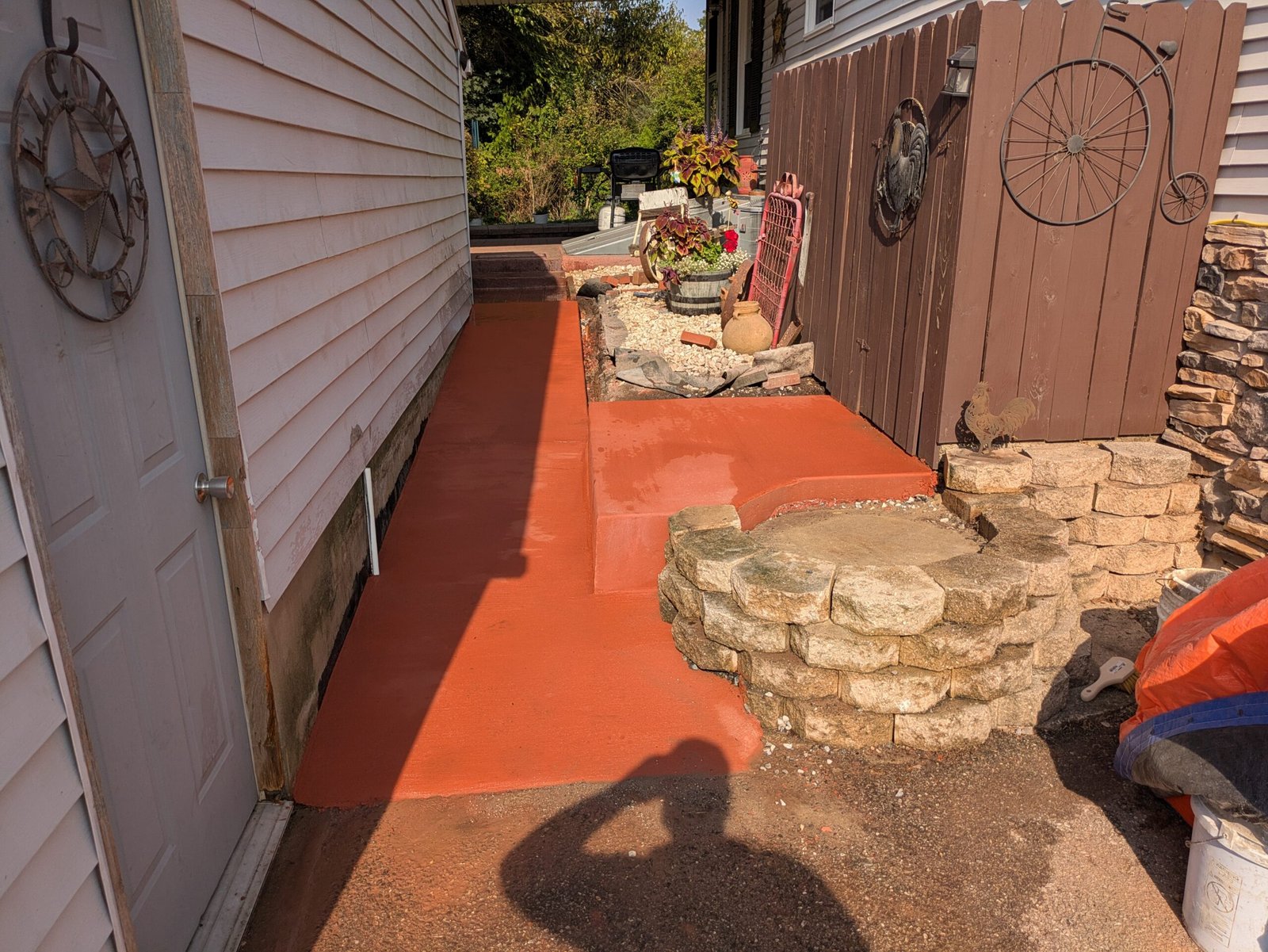
Concrete resurfacing with colored overlay and dry-stack stone garden wall, York PA. Fall 2024.
L
LBE Masonry Team
Licensed Masonry Contractors, York County PA
Concrete resurfacing is one of the most underused options in residential masonry. Most homeowners do not know the concrete they have been looking at for twenty years can be transformed without tearing it out. We like showing people what is possible.
Concrete Ramp & Entryway Replacement Removal of existing brick steps and walkway, followed by installation of a new red-colored concrete access ramp designed for improved safety, accessibility, and long-term durability. Project also included retaining wall block installation around the existing well pump access area to provide clean grading transitions and a finished appearance.
That changed when we showed up for the estimate. We do not always lead with resurfacing as the answer on a concrete job. Sometimes the slab is too far gone and replacement is the right call. This one was not. The structural condition was solid. What it needed was a fresh surface and a reason to exist in the backyard design rather than just being the thing you walked on to get through the gate.
The homeowner had a clear vision once we started talking through options: terracotta-toned color to warm up the space, a dry-stack stone feature wall and raised planter to anchor the corner, and the whole side yard tied together as a real outdoor space instead of a utility corridor between the house and the fence.
She called it a side yard. We looked at it and saw a garden room that just needed some help getting there.
Sometimes the best projects start with someone finally deciding the space deserves better.A thing we have noticed: Side yards are the most neglected square footage on any residential property. Every homeowner walks through them twice a day and looks at the ground the entire time. This project is proof that it does not have to be that way. Although we do understand that staring at the ground is a valid life choice.
What We Did on This Project
Two separate scopes, one visit, one crew. The concrete resurfacing and the stone work were planned together so the finished space reads as a single design rather than two unrelated projects that happened to end up next to each other.
01
Surface Preparation
The existing slab was cleaned, any loose material was removed, and the surface was profiled so the overlay would bond properly. Surface prep is where resurfacing jobs succeed or fail. Skipping it is how you end up with a colored overlay that peels in one season.
02
Crack Repair and Patching
Surface cracks were filled and feathered before the overlay went down. The goal is to prevent those cracks from reflecting through the finished surface, which happens when the underlayer moves and the overlay does not have enough flexibility to absorb it.
03
Colored Concrete Overlay
A polymer-modified concrete overlay in a terracotta/red oxide tone was applied over the prepared slab. This is not paint. It is a thin masonry product that bonds to the existing concrete and cures as part of it. It handles Pennsylvania freeze-thaw cycles without peeling or delaminating when installed correctly.
04
Dry-Stack Stone Garden Wall and Raised Planter
Natural stone laid dry-stack to create a raised planter feature in the corner. The rounded top course gives it a finished profile and a stable surface. The stone ties visually to the existing stonework on the fence post at the gate.
05
Sealer Application
A penetrating sealer was applied to the finished overlay to protect the color and make the surface easier to maintain. In a side yard that sees regular foot traffic and weather exposure, sealing is not optional.
Verified Google Review
★★★★★
I genuinely could not believe it was the same slab. The color is exactly what I wanted and the stone planter ties the whole area together. I had been meaning to do something with that side yard for probably ten years. LBE got it done in a day and it looks like a completely different property. Highly recommend.
Concrete Resurfacing vs Full Replacement: How to Decide
This is the first question we answer on every concrete estimate. The decision matters because the two options are very different in scope, disruption and cost.
Resurfacing makes sense when the existing slab is structurally intact. No heaving, no significant settling, no foundation issues underneath. Surface cracks, staining and worn appearance are all resurfacing candidates. You are working with a slab that is still doing its structural job but no longer looks the way you want it to.
Replacement makes sense when the slab has heaved from tree roots or frost, settled unevenly, developed significant structural cracking, or when the substrate underneath has failed. Putting a new overlay on a slab that is moving is a waste of money. The overlay will crack and separate, usually within a season.
Industry guidance: The Concrete Network recommends resurfacing only when the existing slab has no structural compromise and when proper surface preparation (cleaning, profiling, crack repair) is completed before any overlay product is applied. A resurfaced slab that was properly prepped and sealed can last fifteen to twenty years in a Pennsylvania climate. One that was not prepped correctly may not survive the first winter.
Colored Concrete Overlays: What Are the Options
Most homeowners do not realize how many color and finish choices are available with modern concrete overlay products. The terracotta tone on this project is one of the more popular choices we install in York County, but it is far from the only one.
Pennsylvania climate note: Not all overlay products perform equally in York County’s freeze-thaw climate. We only use polymer-modified overlays with a minimum flexural strength rating appropriate for outdoor use in Zone 6b. Products marketed for southern climates or interior use will fail during a Pennsylvania winter. If you are getting multiple bids on a resurfacing job, ask specifically what product the contractor plans to use and whether it is rated for your climate zone.
Dry-Stack Stone Walls: What They Are and When They Work
The raised planter on this project uses a dry-stack technique, which means the stones are laid without mortar. The wall holds together through gravity, friction and the way the stones are fitted together.
Dry-stack works well for garden features, low retaining walls and planters where the structural loads are modest and drainage through the wall is actually desirable. Water moves freely through a dry-stack wall instead of building up behind it, which makes it a good choice for a raised planter where roots and irrigation water need somewhere to go.
For retaining walls over about three feet, or walls that need to hold significant soil loads, a mortared wall is the right call. Dry-stack walls look great and last for decades when used in the right application, but they are not structural retaining walls and should not be treated as such.
If you are thinking about a larger retaining wall on your property, check out our full services page where we cover the difference between decorative garden walls and structural retaining walls, or take a look at some of our completed retaining wall projects in York County.
Where We Work
We do concrete resurfacing, colored overlays, dry-stack stone features and full masonry work across York County and Adams County. If you have a concrete slab you have been looking at for years and wondering if it can be saved, the answer is probably yes. Send us a photo and we will give you a straight answer.
📍 York, PA
📍 Shrewsbury
📍 Glen Rock
📍 Hanover
📍 Spring Grove
📍 New Freedom
📍 Carroll Valley
📍 Adams County
Have a Concrete Slab That Needs Help?
Send us a photo and we will tell you honestly whether resurfacing makes sense or whether replacement is the better call. No upselling, no pressure.
Get a Free EstimateProject Details
Job Summary
Location
York, PA (York County)
Work Done
Concrete surface preparation, crack repair, polymer-modified colored overlay in terracotta tone, penetrating sealer, dry-stack stone raised planter feature
Materials
Polymer-modified concrete overlay, red oxide color integral pigment, penetrating concrete sealer, natural fieldstone dry-stacked
Time on Site
1 day
Completed
Fall 2024
Permit
Not required (surface treatment and decorative stone feature)