
Why Your Retaining Wall Is Leaning (And How to Fix It)
A leaning retaining wall is not a cosmetic problem. Here is what is actually causing it, how to tell whether it can be repaired, and what happens if you ignore it.
 LBE Masonry — York County PA
A retaining wall that starts to lean is one of those problems most homeowners watch for a while before calling anyone. It leans a little, then a little more, and somewhere along the way the mental math shifts from “I should get that looked at” to “well, it has been like this for two years and nothing has happened.”
Then something happens. The wall fails after a heavy rain, soil moves, and what was a $2,000 repair becomes a $12,000 emergency rebuild plus landscaping damage. We see this sequence regularly on projects across York County. This guide covers why walls lean, how to read the signs, and what the actual fix looks like depending on how far things have gone.
When to act immediately
If your wall is leaning more than 2 inches from vertical, has visible horizontal cracks along the base, or is bulging outward in the middle, stop waiting. A wall under active hydrostatic pressure can fail quickly and without much warning, especially after heavy rain or a hard freeze.
The 5 Most Common Reasons a Retaining Wall Leans
Retaining walls do not lean randomly. There is always a structural reason. Most of the time it comes down to one of five things, and drainage is involved in four of them.
1
No drainage behind the wall
The single most common cause. Water builds up in the soil behind the wall, creates hydrostatic pressure, and pushes outward. A wall designed for soil pressure alone cannot handle soil-plus-water pressure. Even a well-built wall without proper drainage will eventually lean. This is why we never skip the gravel backfill and perforated pipe on a new installation.
2
Freeze-thaw damage to the base
York County averages 20 or more freeze-thaw cycles per winter. Water gets into the soil behind or beneath the wall, freezes, expands, and shifts the base. Walls without a footing below the frost line are especially vulnerable. Once the base moves, the wall tilts and does not go back.
3
Inadequate base depth or compaction
A retaining wall is only as stable as what it is sitting on. If the base gravel was not compacted properly, or if the footing is too shallow, the wall will settle unevenly over time. This shows up as tilting to one side, sinking at one end, or a progressive lean that gets worse each year.
4
Missing or failed geogrid reinforcement
Walls taller than 3 to 4 feet need geogrid layers buried in the backfill to anchor the wall against lateral soil pressure. Many older walls and some contractor-built walls were installed without geogrid, or with geogrid that was placed incorrectly. Without it, a tall wall has nothing resisting the soil pushing from behind.
5
Surcharge load the wall was not designed for
Adding weight behind a wall after it is built, like a new driveway, a parking area, heavy planters, or a deck, increases the load the wall has to resist. A wall that was fine for a garden bed may not be adequate once a vehicle is parking 4 feet behind it. This is a more common cause of leaning than most homeowners expect.
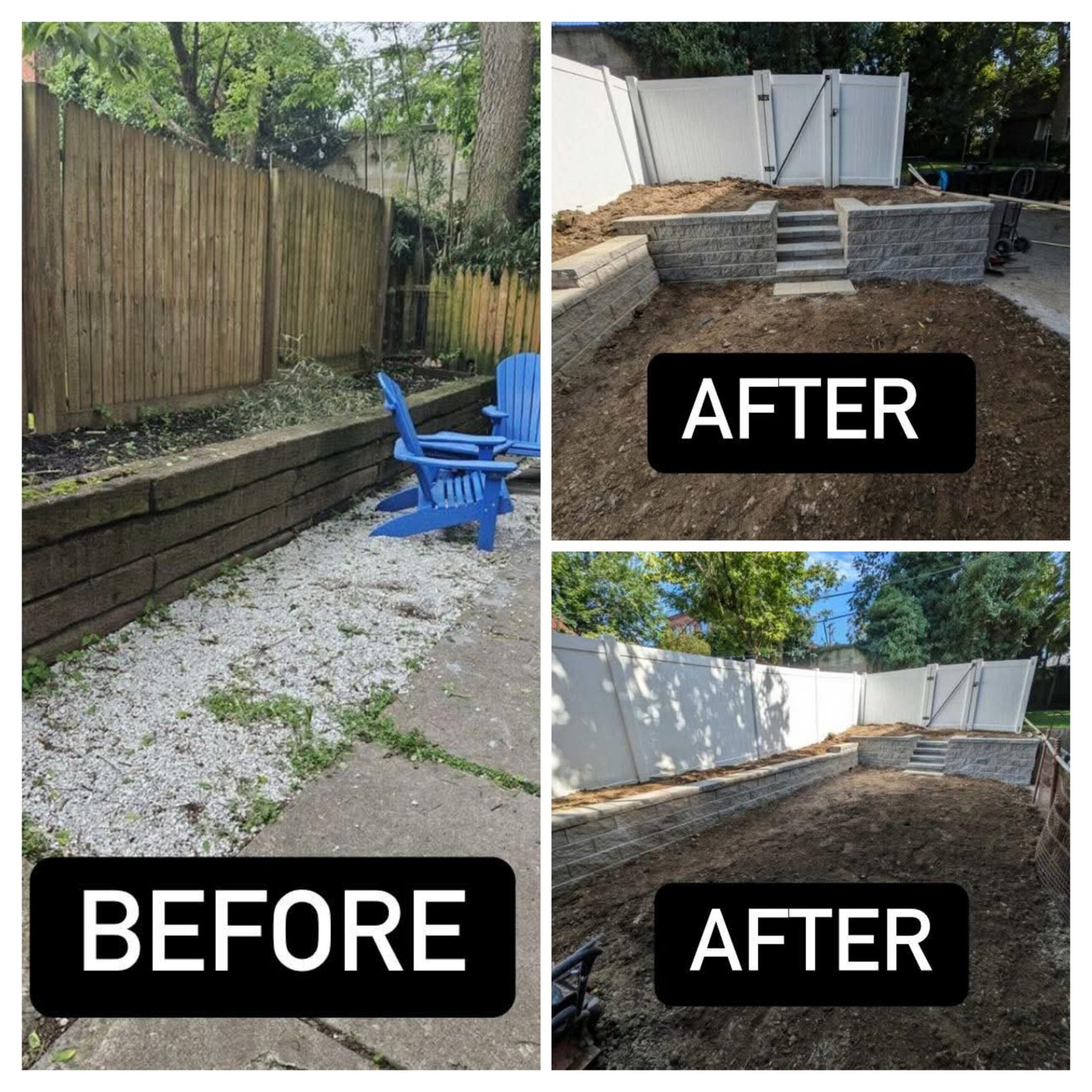
Before
After
A failed block retaining wall in York County rebuilt by LBE Masonry with proper base, drainage, and geogrid reinforcement.
Hydrostatic pressure is the silent killer of retaining walls. Most homeowners never see the water building up behind the wall. They just see the result when it starts to move. Proper drainage is not an optional upgrade — it is the reason the wall lasts.American Society of Civil Engineers — Residential Retaining Wall Failure Analysis, 2023
How to Tell Whether Your Wall Can Be Repaired or Needs a Rebuild
This is the question we get asked most often on-site. The honest answer is that it depends on how far the movement has gone and what caused it. Here is a practical way to think about it:
Repair vs Rebuild — Decision Guide
| What you see | Likely cause | What it means |
|---|---|---|
| Lean of 1 inch or less, no cracking | Early drainage pressure | Often repairable. Add drainage, reset affected courses. |
| Lean of 1 to 3 inches, minor cracking | Drainage failure or base settlement | Partial rebuild likely. Assess base and drainage before deciding. |
| Lean over 3 inches or active movement | Structural failure | Full rebuild required. Do not delay. |
| Horizontal crack near base | Overturning or base failure | Full rebuild. This crack pattern means the wall is failing. |
| Vertical cracks, blocks separating | Uneven settlement or frost heave | Partial to full rebuild depending on extent. |
| Bulging outward in the middle | Missing or failed geogrid | Full rebuild with geogrid reinforcement. |
| Mortar crumbling, no movement | Age and weathering | Tuckpointing or repointing. No structural rebuild needed. |
The honest truth about patching
Pushing a leaning wall back and filling cracks does not fix a leaning wall. It addresses the appearance while the underlying cause keeps working. If the drainage is not corrected and the base is not re-established, the wall will lean again. We only repair walls where the repair actually solves the problem.
 LBE Masonry — York County PA
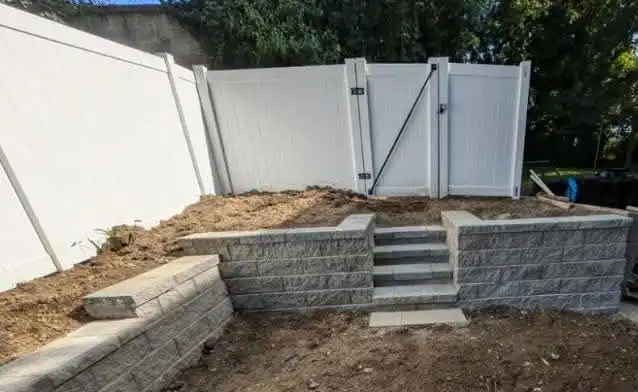
Proper base preparation and drainage installation during a retaining wall rebuild in York County. This is the work that makes the difference between a wall that lasts 5 years and one that lasts 50.
How a Proper Retaining Wall Repair Works
A retaining wall repair that actually holds is not a simple job. Anyone who tells you they can fix a leaning wall in an afternoon without excavating behind it is not fixing the problem. Here is what a proper repair process looks like:
1
Assess the wall and identify the root cause
Before any work starts we determine why the wall moved. Is it drainage? Base failure? Inadequate reinforcement? Surcharge load? The answer determines what the fix looks like. Skipping this step is why walls fail again after repair.
2
Excavate the backfill
The soil behind the wall has to come out. There is no way to address the base or install drainage without excavating. This is typically the largest part of the job and the one most patch-repair contractors skip to save time.
3
Reestablish or rebuild the base
Compacted gravel base, at the right depth, below the frost line. If the footing was insufficient the first time, this is where the problem gets corrected permanently.
4
Install proper drainage
Perforated drain pipe at the base of the wall, surrounded by clean gravel, with positive drainage away from the wall. This is the step that prevents the problem from coming back. It is not optional on any wall we rebuild.
5
Rebuild with geogrid where needed
For walls over 3 feet, we install geogrid reinforcement layers as we rebuild. The geogrid anchors the wall into the backfill and distributes the lateral load over a much larger area.
6
Backfill and compact in lifts
Soil goes back in controlled layers, each compacted before the next goes in. Dumping fill in all at once creates uneven settlement and voids. This step takes time and that is intentional.
What Does Retaining Wall Repair Cost in York PA?
Repair costs depend heavily on how far the problem has gone. A minor drainage fix and block reset runs very differently from a full tear-down and rebuild. Here are realistic ranges for projects in York and Adams County:
Retaining Wall Repair Cost Estimates — York County PA 2025
| Repair type | Typical range | What it includes |
|---|---|---|
| Minor repair, 1–2 courses reset | $800 – $2,500 | Block reset, drainage improvement, backfill |
| Partial rebuild, 20–30 ft section | $3,000 – $7,000 | Excavation, base work, drainage, rebuild |
| Full rebuild, 30–50 ft wall | $7,000 – $14,000 | Full demo, new base, drainage, geogrid, rebuild |
| Full rebuild, tall wall (4–6 ft) | $12,000 – $22,000+ | Engineering review, permit, full structural rebuild |
| Tuckpointing only (no structural issue) | $500 – $2,000 | Mortar joints repaired, no excavation |
One number worth keeping in mind: a wall that fails completely and damages adjacent landscaping, a driveway, or a foundation can cost two to five times more to remediate than a timely repair would have. Watching a leaning wall is not free.
★★★★★
“Our block wall had been leaning for about three years. We got two quotes from contractors who both said they could push it back and fill the cracks. LBE was the only one who told us that would not fix it, explained exactly why it was leaning, and gave us a real repair plan. They excavated, installed drainage, and rebuilt the section properly. It has been solid through two winters now.”
James K., York PA
Verified Customer
Can You Fix a Leaning Retaining Wall Yourself?
For a small decorative wall under 2 feet that has shifted slightly, a motivated homeowner with a rented plate compactor and some gravel can address minor drainage and reset a few blocks. There are good YouTube tutorials and the risk of failure is limited.
For anything structural, anything taller than 2 to 3 feet, or any wall that is showing active lean or cracking, the honest answer is no. The work that matters happens behind the wall, underground, where you cannot see it. Cutting corners there is how you end up with a wall that looks fixed and fails again in 18 months. More importantly, a wall that collapses is a liability. If it damages a neighbor’s property or injures someone, the owner of the wall is responsible.
York County permits
Rebuilding a retaining wall taller than 4 feet in York County requires a building permit. Unpermitted structural work on a wall this size can create title issues when you sell. We handle permit applications as part of any qualifying project. See York County permit requirements for current details.
Common Questions
How much lean is too much for a retaining wall?
Most structural engineers consider 1 inch of lean per foot of wall height to be the outer limit before active intervention is needed. In practice, any wall showing progressive lean over multiple seasons, or any lean paired with cracking, should be assessed before the next winter. Freeze-thaw cycles accelerate movement once it starts.
How long does a retaining wall repair take?
A minor repair, resetting blocks and adding drainage, can take 1 to 2 days. A partial rebuild of a 20 to 30-foot section takes 3 to 5 days. A full rebuild of a longer or taller wall typically runs 5 to 10 days depending on site access and backfill requirements. We give you a realistic timeline in the estimate.
Will my homeowner’s insurance cover a retaining wall repair?
Most standard homeowner’s policies do not cover retaining wall failure unless it is caused by a sudden, covered event like a vehicle impact or a named storm. Gradual failure from drainage or age is generally excluded. It is worth calling your insurer before assuming coverage either way.
Can I add drainage to an existing wall without tearing it down?
Sometimes. If the lean is minor and the wall is otherwise stable, a surface drain or French drain installed behind the wall at grade can reduce water pressure without full excavation. This is a case-by-case assessment. On a wall that is already moving, surface drainage alone is usually not sufficient and excavation is needed.
What areas do you serve for retaining wall repair?
We repair and rebuild retaining walls throughout York County and Adams County including York, Hanover, Spring Grove, Shrewsbury, Glen Rock, New Freedom, Red Lion, Dallastown, Carroll Valley, and surrounding communities. Not sure if you are in our area? Just call us.
Wall Leaning? Get It Assessed Before It Gets Worse.
We come to your property, look at the wall, and tell you honestly what it needs and what it will cost. Free estimate, no pressure.
Request a Free EstimateLBE Masonry repairs and rebuilds retaining walls throughout York County and Adams County PA. We also install paver patios and handle brick and stone repair across the region. Photos in this post are original LBE Masonry project photography. Permit requirements referenced from York County Planning and Zoning (2025).