
Block vs Stone Retaining Wall: Which Is Right for Your Yard?
Two great materials. Very different results. Here is how to pick the right one for your property in Hanover and the surrounding area, without guessing.
Concrete block or natural stone. It is the question we hear most often from homeowners in Hanover, Abbottstown, McSherrystown, and across Adams County when a retaining wall project comes up. Both materials build a solid, long-lasting wall. Both handle Pennsylvania winters. Both look good on the right property.
The difference comes down to what you need the wall to do, what your yard already looks like, and how much you want to spend. This guide covers the real tradeoffs so you can make that call before the first estimate arrives.
The Short Answer
Neither answer is universally correct. A homeowner in Hanover with a modern home and a 60-foot sloped backyard may be perfectly served by concrete block. A homeowner in Fairfield with a fieldstone farmhouse and a small terrace wall is probably looking at natural stone. Let us walk through why.
Head-to-Head Comparison
Block vs Stone Retaining Wall — Key Differences
| Factor | Concrete Block | Natural Stone |
|---|---|---|
| Cost installed | $30–$50 / sq ft | $40–$95 / sq ft |
| Lifespan | 50–100 years | 75–200+ years |
| Appearance | Clean, modern, uniform | Organic, timeless, unique |
| Drainage | Requires engineered system | Natural drainage through gaps |
| Tall walls (4 ft+) | Excellent with reinforcement | Best under 3–4 ft without engineering |
| Maintenance | Periodic sealing, crack checks | Minimal, weathers naturally |
| Installation time | Faster, predictable | Slower, skill-dependent |
| Property value impact | Good | Excellent |
Concrete Block Retaining Walls
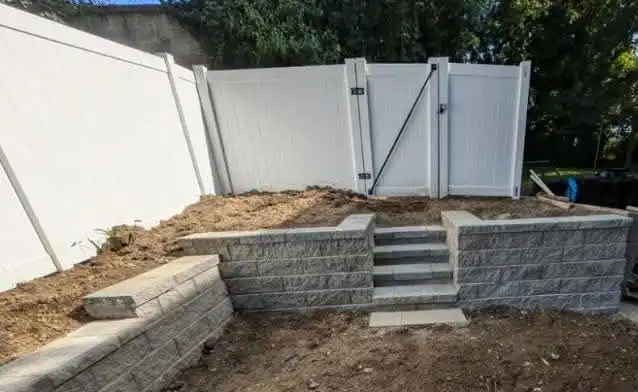
Concrete block, also called segmental retaining wall block or SRW block, is the most popular choice for residential retaining walls across York County and Adams County. Brands like Allan Block, Belgard, and Versa-Lok make up the bulk of what we install. The blocks interlock without mortar, which makes them faster to build and easier to repair than a poured or mortared wall.
For a sloped backyard in Hanover, a typical block wall runs $30 to $50 per square foot installed. A mid-size project, say 40 feet long and 3 feet tall, usually comes in between $5,000 and $9,000 depending on drainage requirements and site access. Taller walls need geogrid reinforcement buried in the backfill, which adds cost but also adds decades of stability.
Pros
- Lower cost than natural stone
- Handles tall walls and heavy loads well
- Consistent, engineered appearance
- Wide range of colors and textures
- Faster installation
- Can mimic stone look at lower price
Cons
- Needs engineered drainage system
- May need sealing over time
- Can crack in freeze-thaw without proper base
- Manufactured look, not fully organic
- Shorter lifespan than natural stone
Pennsylvania climate note
York and Adams County average 20+ freeze-thaw cycles per winter. Concrete block holds up well when the base compaction and drainage are done correctly. Cut corners on the base and you will see leaning within 5 years. This is the part of the job that matters most.
Natural Stone Retaining Walls
Natural stone walls are built from fieldstone, limestone, granite, or bluestone, either dry-stacked or set with mortar depending on height and application. They are the material of choice when you want the wall to look like it has always been part of the landscape.
In and around Hanover, stone walls fit naturally into properties with existing fieldstone features, rural character, or older homes. They also pair exceptionally well with gardens. A stone wall does not just hold back soil. It becomes part of the landscape in a way that block rarely does.
The cost reflects the skill involved. Natural stone walls run $40 to $95 per square foot installed, with the wide range depending on stone type, whether the wall is dry-stacked or mortared, and how complex the site is. The tradeoff is that a well-built stone wall can last generations. Documented natural stone walls routinely exceed 75 to 100 years, and dry-stack fieldstone walls from the 1800s still stand across Adams County farmland.
Pros
- 75–200+ year lifespan
- Organic, timeless appearance
- Natural drainage through gaps (dry-stack)
- Low long-term maintenance
- Every wall is unique
- Strong property value boost
Cons
- Higher upfront cost
- Requires skilled mason
- Best under 3–4 ft without added engineering
- Slower installation
- Limited color and texture consistency
Natural stone is the Cadillac of retaining walls: timeless, rugged, and nearly permanent. For durability and a timeless look, it is undefeated. The catch is that it requires a skilled mason and the upfront cost reflects that.Buckland Landscaping — Best Retaining Wall Materials Guide, 2025
Which One Is Right for Your Yard?
Here is how to think about the decision based on your specific situation in Hanover or the surrounding area:
Choose concrete block if
Block Makes Sense
- Your wall needs to be taller than 3–4 feet
- Budget is the primary concern
- You want a clean, modern look
- The project is long (60+ feet)
- You are adding a paver patio nearby
- Timeline matters and you want it done faster
Choose natural stone if
Stone Makes Sense
- Your property has existing stone features
- The wall is under 3 feet and decorative
- Aesthetics matter more than budget
- You want a wall that outlasts a mortgage
- Rural or farmhouse property character
- Garden wall or landscape terracing
A third option worth knowing
Stone veneer over a concrete block core gives you the structural strength of block with the appearance of natural stone. It costs more than block alone but less than full natural stone. A good middle ground for homeowners who want the look without the full stone price. Ask us about it during an estimate.
What Pennsylvania Winters Do to Retaining Walls
Hanover sits in USDA hardiness zone 6b. That means 20 or more freeze-thaw cycles each winter, sustained cold snaps, and heavy spring rains. Both concrete block and natural stone handle this climate well when they are built correctly. The key word is correctly.
Freeze-thaw is the enemy of any wall without proper drainage. Water gets behind the wall, freezes, expands, and pushes. Do that 20 times a year for 10 years and something will move. A concrete block wall needs a gravel backfill layer and a perforated drain pipe at the base to keep water from building up. A dry-stack stone wall handles it more naturally because water flows through the gaps. A mortared stone wall needs weep holes.
This is the part most homeowners do not ask about but should. Drainage is not visible in the finished wall. It is also the difference between a wall that stands for 50 years and one that leans in 8. We always include it. Some contractors skip it to lower the quote. That is a question worth asking before you sign.
★★★★★
“Stan did a great job! He arrived on time and was neat and professional in his work. The porch looks great and the price was very fair!!!! I would recommend him whenever you need masonry work done!!!! Great job!!!!”
Vic St Martin
Verified Customer
Common Questions
Can I mix block and stone on the same property?
Yes, and it is more common than you might think. A structural block wall on a steep slope and a dry-stack stone garden wall near the patio are not competing with each other visually if they are in different areas of the yard. We can advise on what makes sense for your specific layout.
Does natural stone hold up better than block in a PA winter?
A properly built block wall and a properly built stone wall both hold up well through Pennsylvania winters. Dry-stack stone has a slight edge because natural drainage reduces hydrostatic pressure. But drainage design matters more than material. A stone wall with poor drainage will fail just as a block wall will.
Do I need a permit for a retaining wall in Hanover, PA?
In most cases, walls under 4 feet do not require a permit in Hanover Borough or Penn Township. Walls 4 feet and taller typically require a permit from Hanover Borough’s building department. Complex walls may also need a structural engineer’s sign-off. We handle permit applications as part of the project.
How long does it take to build a retaining wall?
A typical 40-foot block wall takes 2 to 3 days of work. A stone wall of the same size takes 3 to 5 days because of the hand-fitting involved. We give you a realistic timeline in the estimate and stick to it.
Is it worth spending more for natural stone?
If your property has rural character, existing stone, or you plan to stay for decades, yes. Stone walls return strong value at resale, require almost no maintenance, and look better as they age. If you need a structural wall and budget matters, concrete block is the right call and will serve you well for 50+ years.
Not Sure Which Is Right for Your Yard?
We come to your property in Hanover, look at the slope and what you already have, and give you an honest recommendation before any quote. No pressure.
Get a Free EstimateLBE Masonry builds and repairs retaining walls across York County and Adams County PA, including Hanover, McSherrystown, Abbottstown, Carroll Valley, Fairfield, and surrounding communities. We also install paver patios and handle masonry repair and tuckpointing. Durability data referenced from independent research by Signature Landscape and Buckland Landscaping (2025).